
Expert opinion
“The biggest value of AI in testing is not generating more scripts. It acts as an assistant that handles routine work, accelerates investigation, and allows QA engineers to focus on test strategy, product risks, and user experience.”
— Alena Bogomaz, QA Lead at Gilzor
AI can support almost every stage of the testing lifecycle — from creating test scenarios to analyzing failures in CI/CD pipelines.
Instead of manually searching through multiple files, logs, and reports, engineers can use AI to:
The result is not “fully automated testing”. The result is a faster workflow where engineers spend less time on repetitive operations and more time making quality decisions.
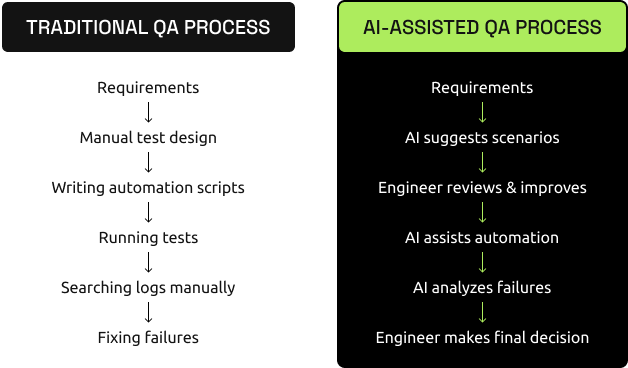
AI can support different testing areas depending on the application architecture and team needs.
Expert insight
“AI is especially useful when teams need to analyze large amounts of testing information — from requirements and logs to failed test results. It can speed up investigation and suggest possible solutions, but QA experience remains essential for understanding the real impact and making the right decisions.”
— Alena Bogomaz, QA Lead at Gilzor
Teams can prepare reusable prompts for common testing activities. This makes AI usage consistent and removes the need to explain the same requirements repeatedly.
"Create an automated test for this user journey. Follow the existing project structure and naming conventions. Reuse shared components where safe, add suitable synchronization, and include positive and negative scenarios. Do not modify unrelated tests."
"Analyze the attached test logs and screenshots. Identify the root cause, distinguish an application defect from a test issue, and propose the smallest safe fix. List any other tests that could be affected."
"Compare this branch with the main branch. Identify modified shared components, find all tests that use them, and classify the regression risk as low, medium, or high."
"Generate API test scenarios from this specification. Include authentication, validation, invalid input, boundary values, permissions, error responses, and schema checks."
"Review this automated test for unstable selectors, duplicated steps, unnecessary waits, weak assertions, hidden dependencies, and possible CI timing problems."
Pre-prepared prompts allow teams to automate parts of their working process, not just individual test scripts. AI handles repetitive analysis while engineers retain control over the final decisions.
Different tools solve different problems.
Teams do not need to adopt every available AI tool. The right combination depends on the existing technology stack, security requirements, testing goals, and development process. In many cases, the most effective approach is combining a general AI assistant with specialized testing tools.
AI-generated tests and recommendations always require human review. A successful test run does not automatically mean the software is correctly tested.
QA engineers still need to ensure that:
The strongest results come from collaboration between AI capabilities and human expertise.
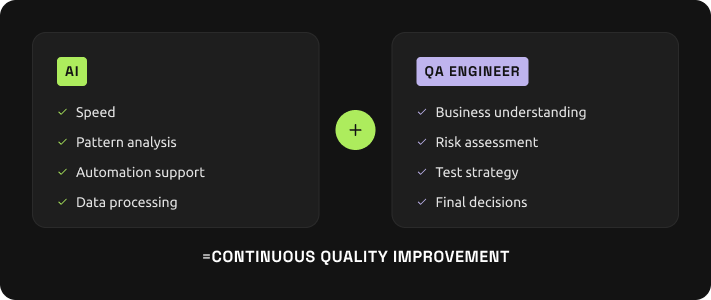
AI can improve almost every part of automated testing — from creating test scenarios and automation scripts to analyzing CI/CD failures and maintaining test suites.
It helps QA teams:
But AI does not replace quality engineers.
Its real value is allowing QA specialists to spend more time on strategic activities: understanding risks, designing better coverage, identifying important defects, and improving the overall product experience.
The future of testing is not AI instead of humans. It is AI working together with experienced QA engineers to build better software faster.

Alena Bogomaz is a QA Lead specializing in test automation, software quality engineering, and building reliable testing processes for modern web, mobile, and backend applications.
Building reliable automated testing requires the right strategy, tools, and engineering approach.
Our QA engineers help companies improve test coverage, automate testing workflows, identify risks earlier, and integrate quality assurance into modern software development processes.