Custodial wallets
and payment backend
for a Web3 domain platform

~25,000

on-chain transactions a month

99%+

of domain transfers go through on the first attempt
Web3
Payments
Blockchain Domains
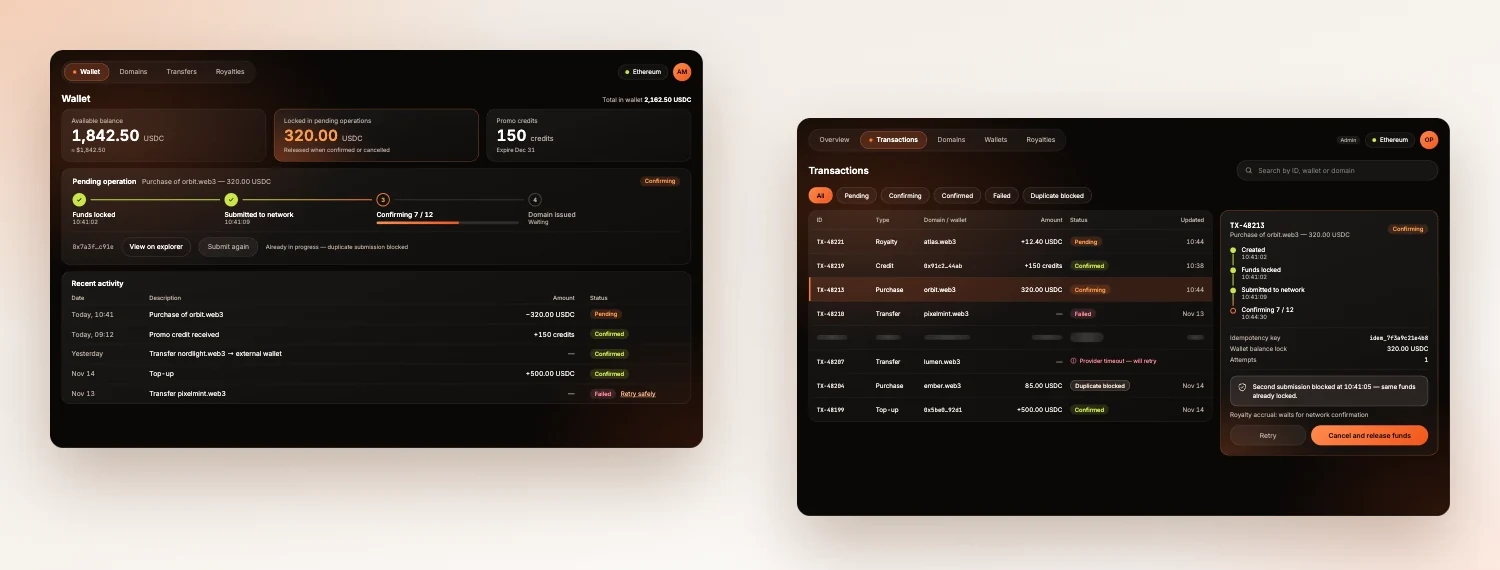
Customer wallet with funds locked in a pending domain purchase, and the admin transaction list with a blocked duplicate submission

About the client

A Web3 platform for managing blockchain domains, wallets and royalties. Domain zone owners issue domains to their users and earn royalties on sales and renewals. The product has a customer app and an admin panel.

Founders’ goals

Let users own and transfer domains without dealing with wallets, seed phrases or network fees
Run promotions and internal credits without the risk of losing money to balance accounting errors
Accrue royalties accurately, and only for completed transactions
Add new blockchain networks without reworking the product

Needs

Secure key storage for custodial wallets through a specialized custody provider
A payment backend that withstands repeated requests, failures and delayed blockchain confirmations
Interfaces that always show the current status of a transaction
A team that could quickly take over and stabilize payment flows, domain transfers and royalties already running in production

Challenges

01

Double charges

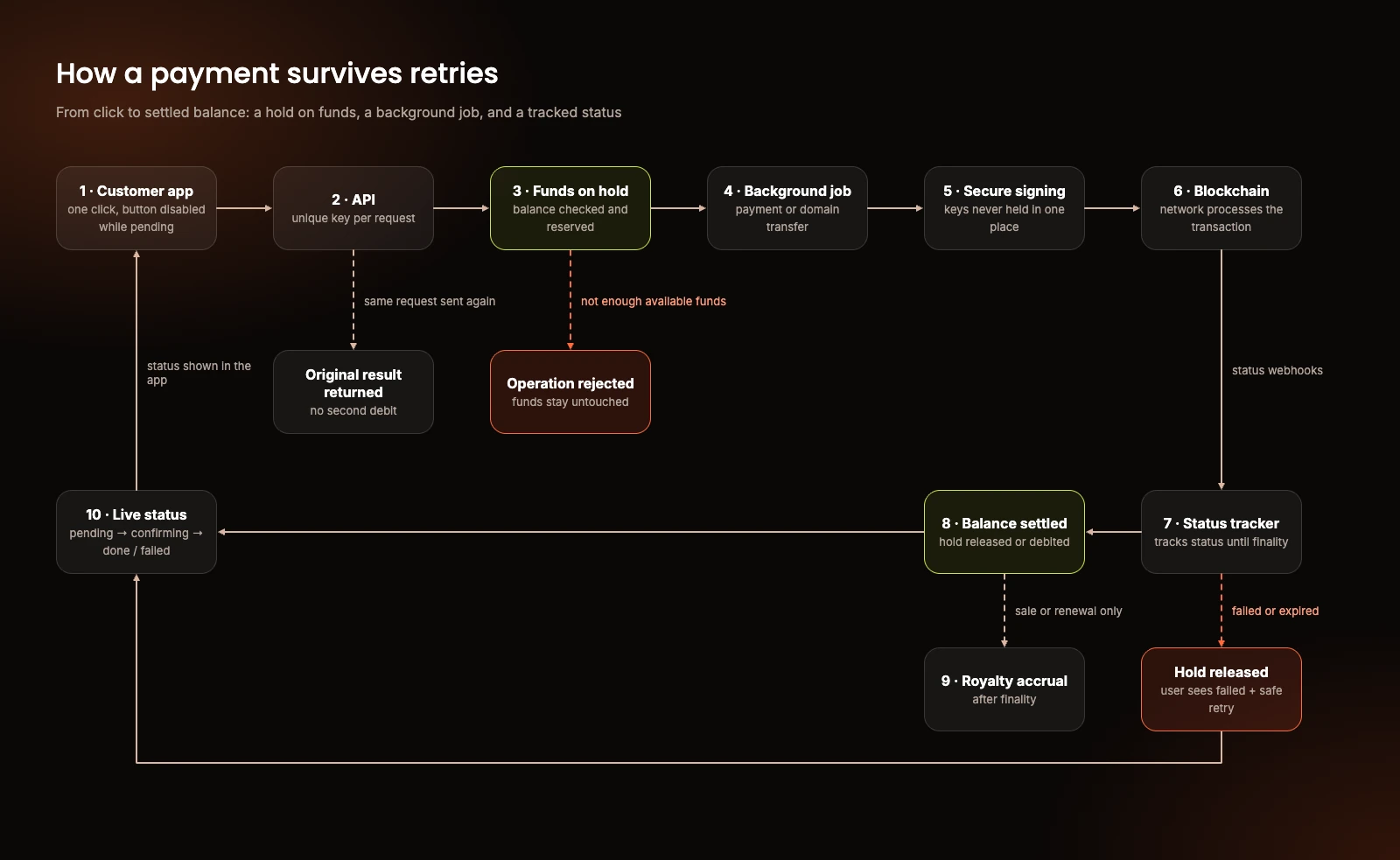
Several requests and background jobs could change the same balance at the same time. That is especially risky when promotions and credits run on top of the balance. We made balance operations idempotent, so a repeated request never creates a second charge. Funds are reserved until the operation completes, and the insufficient-funds check is atomic, done in a single update.

02

Asynchronous transactions

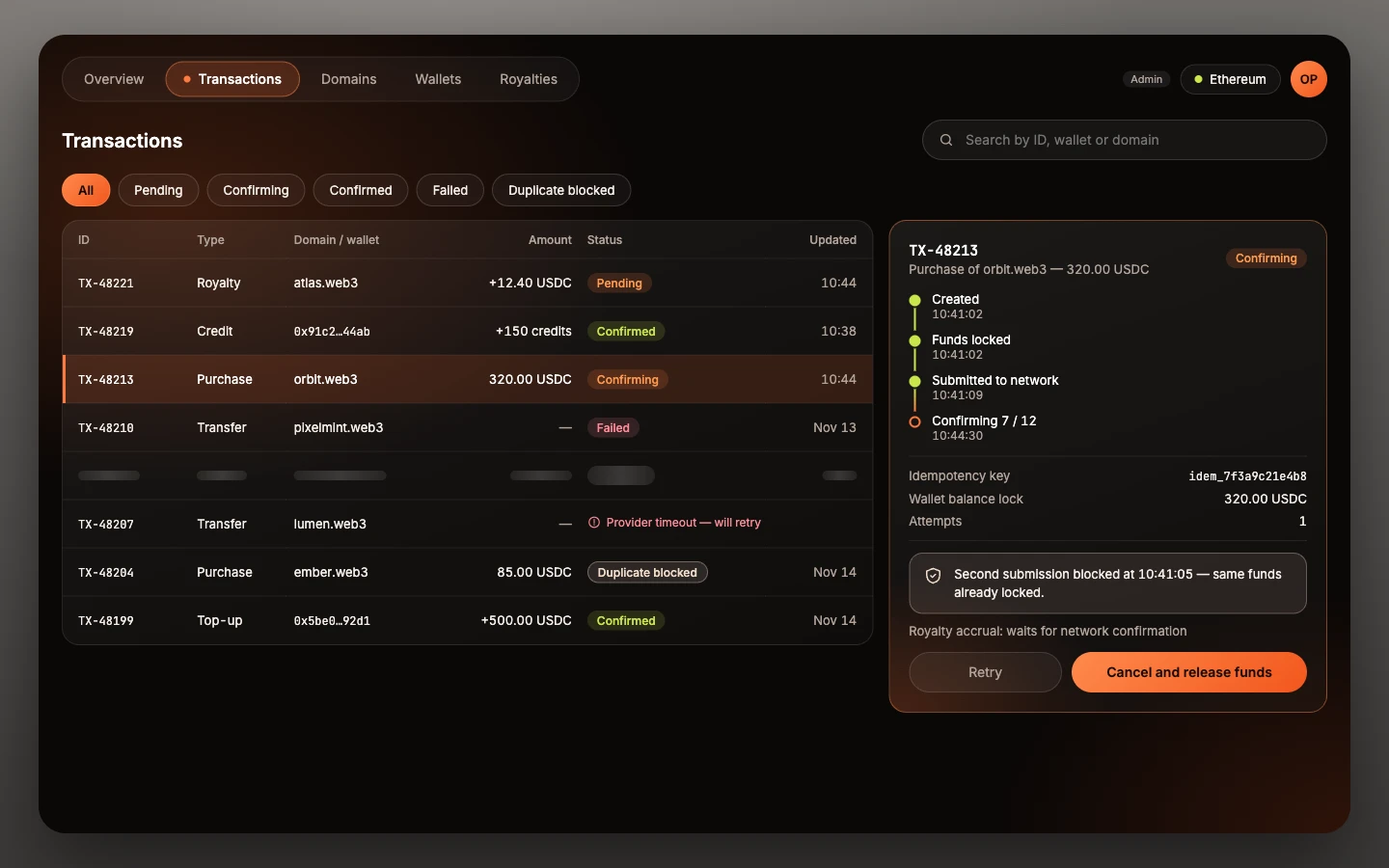
A blockchain transaction doesn't complete instantly: on some networks it takes seconds, on others minutes. It can also get stuck or fail. We track every status change, handle repeated and late notifications from the custody provider, and block a transaction from being resubmitted until the first attempt has finished.

03

Payments, domain transfers and royalties

All three flows use the same wallets, and each had its own failures under asynchronous processing. We found and fixed the weak spots in error handling and late confirmations. Royalties are now accrued only after a transaction is final on the blockchain.

04

Consistent interface states

Loading, errors and empty data looked different from screen to screen, so real failures were easy to miss. We introduced one approach for the customer app and the admin panel: clear loading states, request retries and error messages that explain what to do next.
Solution development

Payment Backend

Payments, custodial wallets and domain transfers run on Node.js and NestJS services. Every balance operation carries an idempotency key, and the funds are locked before a background job hands the transaction to the custody provider, so keys never leave Fireblocks. A status tracker counts network confirmations. Only after that is the balance settled and the royalty accrued, and the new status reaches the screen. A second click on the same payment hits the lock, and the user sees that the operation is already in progress.

What We Built

Custodial Wallets on Fireblocks

User wallets are custodial, with MPC key management through Fireblocks. Users own and transfer domains without seed phrases or network fees.

Blockchain Domains

Issuing, transferring and managing blockchain domains through these wallets.

Customer App and Admin Panel

Domains, wallets, royalties and transaction history in a customer app and an admin panel.

Discounts, Promotions and Credits

Discount systems, promo campaigns and internal credits that run on top of user balances.

Double-Charge Protection

Idempotent balance operations and fund reservation: a repeated request never creates a second charge.

Background Processing

Payments, domain transfers and royalty accrual run as background jobs with safe retries.

Transaction Status Tracking

Every status change of a transaction is tracked, and the interface stays in sync with the server.

EVM Networks and Solana

A shared layer that doesn't depend on a specific network, so new chains can be added without reworking the product.

Loading, Error and Empty States

One approach across the customer app and the admin panel, so a real failure is never mistaken for slow loading.
Tech stack

Payment Platform Tech Stack

Backend

Node.js
NestJS

Frontend

Angular
TypeScript
RxJS
NgRx ComponentStore

Databases

MongoDB
Redis

Key management

Fireblocks
MPC

Networks

EVM
Solana
Admin panel: transaction list with statuses, idempotency key, balance lock and a blocked duplicate submissionHow a payment survives retries: customer app, API with a unique key per request, funds on hold, background job, secure signing, blockchain, status tracker, balance settled, royalty accrual and live status; repeated requests return the original result, insufficient funds are rejected, failed or expired transactions release the hold

Achieved

results

No double charges

Since balance protection went live in production

~25,000

On-chain transactions a month

99%+

Domain transfers go through on the first attempt; the rest show their status and can be safely retried

~60%

Fewer support requests about stuck or unclear payments