Solution development
How it works
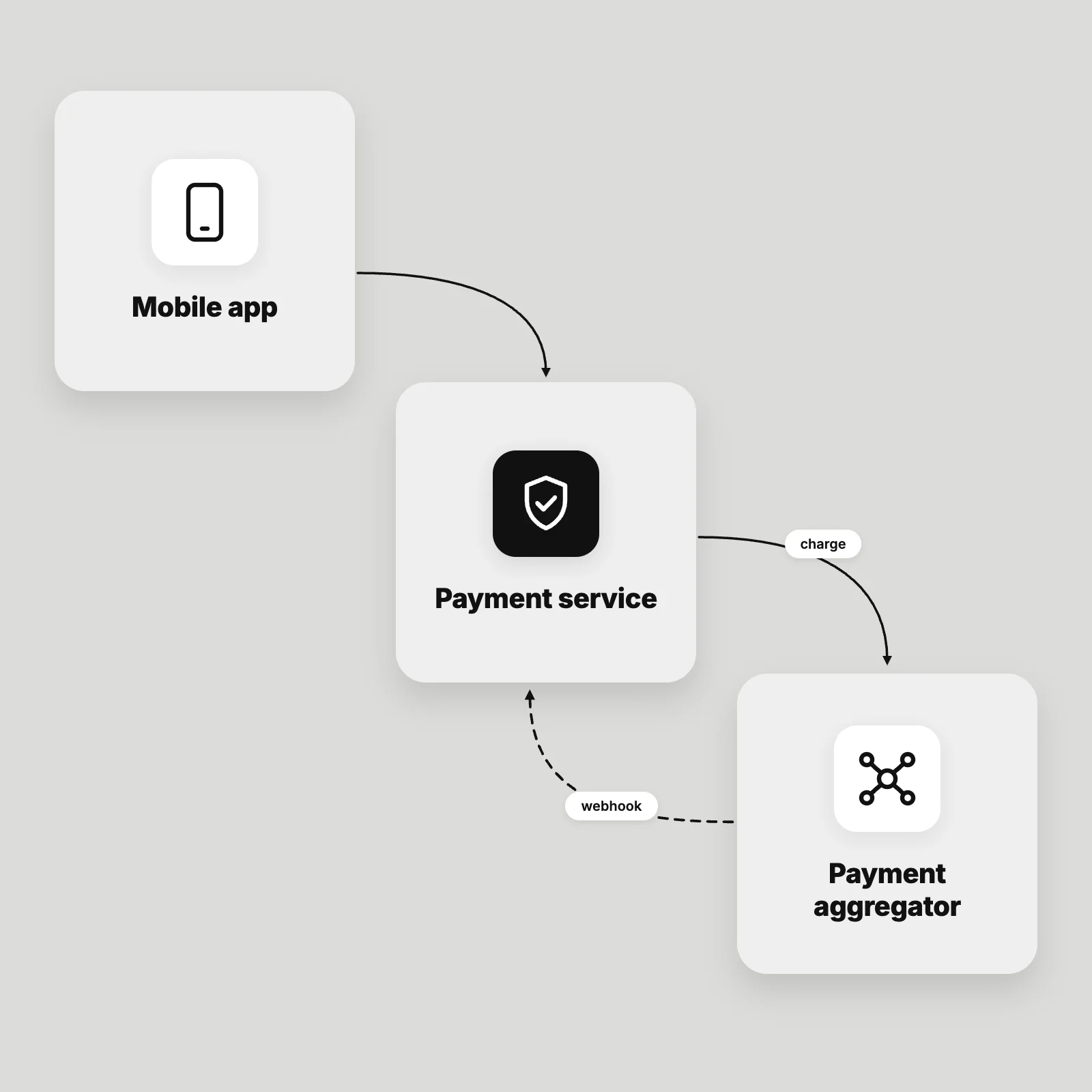
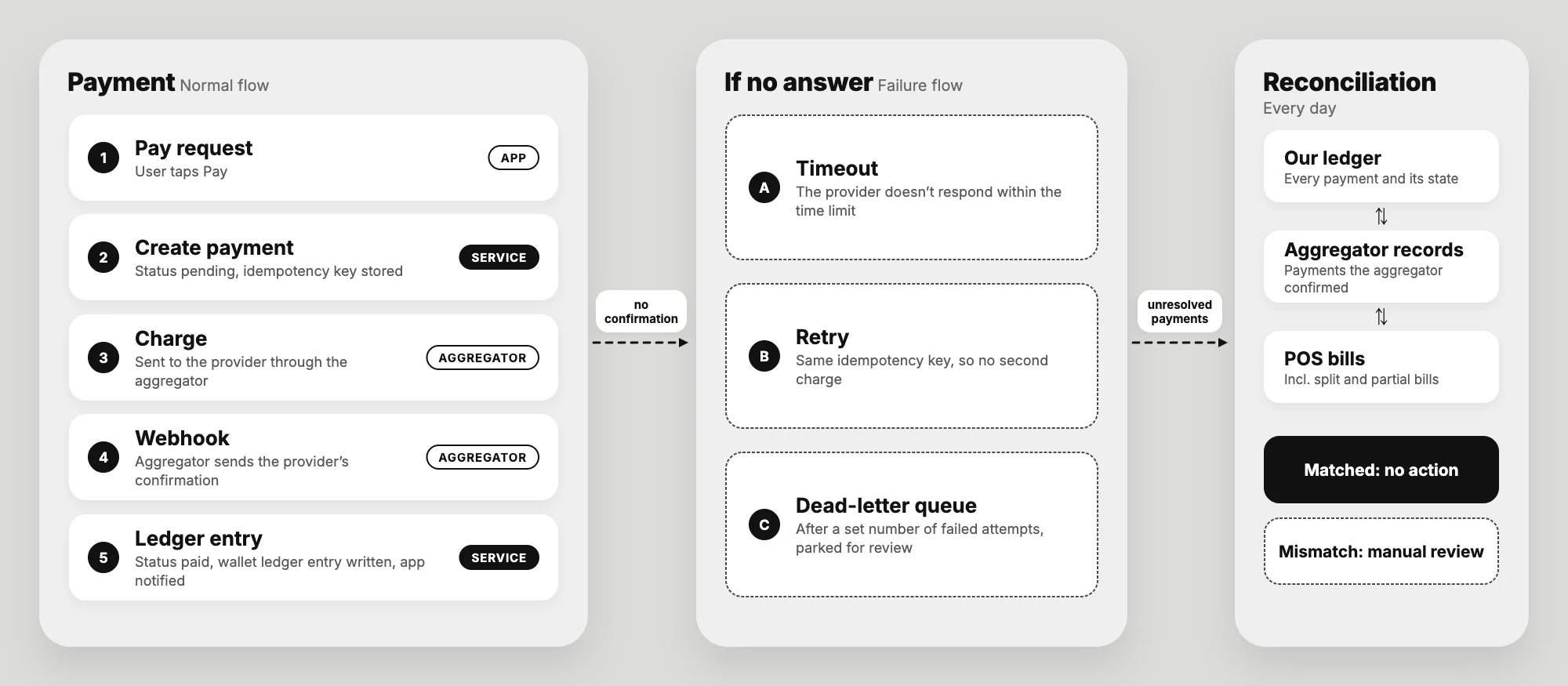
The payment layer is provider-agnostic: the app talks to our backend, and the backend talks to the aggregator. A provider the aggregator already supports can be added without changing the product. A payment moves through five steps:
- Pay request. The user taps Pay in the app.
- Create payment. The backend creates the payment with the status pending and stores an idempotency key.
- Charge. The request goes to the provider through the aggregator.
- Webhook. The aggregator sends the provider’s payment confirmation.
- Ledger entry. The backend sets the status to paid, writes the wallet ledger entry, and notifies the app.
If the provider doesn’t respond, the backend waits for the timeout and retries with the same idempotency key so the retry doesn’t create a second charge. After a set number of failed attempts, the operation goes to a dead-letter queue for review. Once a day, the ledger is reconciled against the aggregator’s records: matched payments need no action, and mismatches go to manual review.
Key Features
Aggregator integration
One integration covers several payment providers and banks. Adding a provider the aggregator already supports doesn’t require app changes.
Payment state tracking
Every payment moves through explicit states, including pending, partial, failed, and refunded, all visible in the admin portal.
Idempotent processing
Repeated requests and duplicate webhooks are processed by key and don’t create a second charge or a second wallet entry.
Retries and a dead-letter queue
Failed operations are retried automatically. Anything that can’t be completed stays in a queue for review instead of disappearing.
Split and partial payments
A bill can be paid in shares or in parts, through the POS or manually, and ends up in one consistent state.
Wallet balances tied to payment status
Credits and debits are posted only against confirmed payments, and refunds are posted as reversing entries.
Reconciliation
Payments are matched against aggregator records and POS bills, with partial and mismatched cases flagged for review.