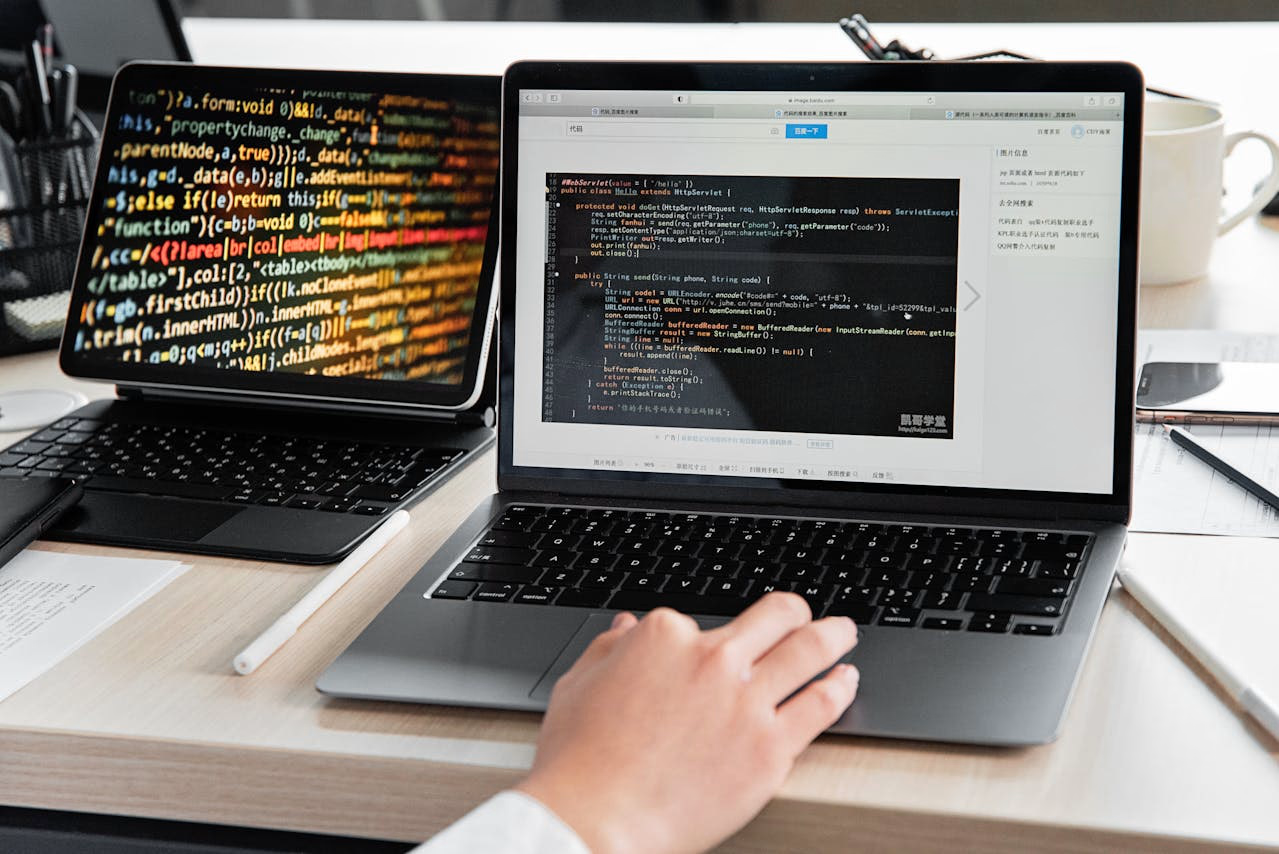
Business IT support companies can cover very different needs, from employee help desks and device management to cloud operations, application maintenance, cybersecurity, and infrastructure monitoring. This overview compares providers with different delivery models so businesses can identify the type of ongoing technical support that fits their environment. The selection focuses on current, verifiable services rather than treating the numerical order as a ranking.
Gilzor provides development-led technical support for businesses running custom web applications, mobile products, and other software systems. Its support and maintenance work includes fixing technical issues, keeping software current, improving performance, and adding functionality after launch. The team can also take over products created by another vendor, which is useful when a business needs a new engineering partner for an existing system.
Its broader service mix includes development, QA, troubleshooting, business analysis, and product work. For small and medium businesses, Gilzor also provides post-launch maintenance intended to keep workflow software operating while developers introduce updates and address emerging issues.

Integris focuses on managed IT for small and midsize businesses, combining day-to-day technical assistance with cybersecurity, technology planning, and managed infrastructure. Its CORE service includes foundational IT support, cybersecurity, Microsoft 365 and data management, workflow automation, and strategic guidance.
The company operates through teams across the United States and can support organizations that want to outsource most IT operations as well as those retaining internal technology staff. Its service model is particularly relevant to companies that want IT support tied closely to security controls and longer-term technology planning instead of relying only on reactive ticket resolution.
A-listware provides structured IT support covering infrastructure, applications, users, and cloud environments. Its support model includes Level 1 user assistance, Level 2 technical troubleshooting, and Level 3 software engineering for issues that require code changes or deeper technical investigation.
The company also offers managed IT services with infrastructure monitoring, server and cloud administration, software updates, vulnerability assessments, NOC management, and IT infrastructure optimization. This breadth makes it relevant to businesses that need both conventional user support and engineering expertise when problems involve applications or custom systems.
Ntiva delivers managed IT services covering employee support, infrastructure, cybersecurity, cloud platforms, and strategic technology consulting. Its managed support plans include 24/7 help desk access alongside server management, security measures, employee onboarding, remote support, and longer-term technology guidance.
A dedicated pod model groups technicians, field staff, account managers, provisioning specialists, and dispatch resources around assigned clients. Ntiva also offers remote support for device issues, networking, software installation, email problems, and security updates, making the company relevant for distributed businesses with employees working from multiple locations.
OSKI Solutions approaches IT support from an engineering perspective, covering applications, integrations, databases, and cloud infrastructure rather than focusing only on basic help desk requests. Its outsourced support engagements can include incident response, monitoring, bug fixing, maintenance, security patching, cloud upkeep, integration support, and smaller ongoing enhancements.
The company also provides managed IT services under defined service levels. These engagements can cover monitoring and alerting, backup verification, application maintenance, AWS and Azure operations, CI/CD pipelines, databases, and incident management. This model fits companies whose operational IT issues often require developers or cloud engineers rather than only end-user support technicians. Oski
Dataprise provides fully managed IT support for small and mid-market organizations, with coverage spanning user support, infrastructure, cybersecurity, backups, and technology strategy. Its managed service includes 24/7 monitoring, patching, endpoint security, help desk support, onsite assistance, and ongoing IT planning.
Businesses can also use Dataprise specifically for service desk support rather than transferring the whole technology environment. Its help desk offering handles ticket management, remote troubleshooting, onsite assistance, and hardware installation. The combination of field services and remote support can be useful for organizations with several offices or a mixture of centralized and distributed employees.
%20(3).webp)
SoftPro combines custom software engineering with ongoing application maintenance and technical support. Its work is especially relevant to companies using web applications, cloud platforms, and Microsoft-based technology that require developers to remain involved after deployment.
The company provides long-term maintenance for software it develops, including updates, bug fixes, performance improvements, and proactive monitoring for web applications. SoftPro also works with Azure, ASP.NET, .NET Core, React, cloud development, and business software, making its support model closer to application and platform engineering than a conventional office help desk.
Executech provides managed IT services with responsibility for day-to-day systems, employee support, infrastructure, security, and technology strategy. Its managed plans include a 24/7 service desk, monitoring, device management, networking, vendor coordination, cybersecurity, and strategic IT guidance.
The company also offers co-managed arrangements for organizations that already employ internal IT professionals. Those engagements can extend internal teams with additional help desk capacity, cybersecurity expertise, cloud specialists, or after-hours coverage. Executech has a physical presence across several western US states, which can matter when businesses need both remote and onsite technical assistance.
net-devs is more engineering-focused than a conventional MSP. The company develops and operates enterprise software across .NET, JVM, Node.js, Python, and Go, while also handling cloud architecture, infrastructure-as-code, platform engineering, QA, deployment, and continued iteration after systems reach production.
For businesses, this model is most relevant when the systems requiring support are custom applications or cloud platforms rather than employee laptops and routine office IT. Its cloud capabilities cover Azure, AWS, and Google Cloud, while the delivery process extends through production deployment and ongoing evolution of the software.
ScienceSoft provides managed IT support spanning infrastructure, applications, networks, cloud services, cybersecurity systems, databases, websites, and employee desktops. Businesses can outsource an entire IT environment or selected components, with services covering administration, proactive monitoring, troubleshooting, patching, and long-term system improvement.
Its help desk supports three escalation levels, ranging from routine user issues to engineering-level software problems. ScienceSoft also works with AWS, Azure, Google Cloud, ServiceNow, Microsoft platforms, Salesforce, SAP, and numerous infrastructure and monitoring tools, making it suitable for organizations with technically varied environments.
Framework IT provides managed IT support built around three connected areas: day-to-day technical support, cybersecurity, and technology strategy. Its services can replace an internal IT department or supplement existing technology staff, depending on the client's resources.
The company works primarily with businesses in the Chicago area and supports more than 4,000 users across over 100 organizations. Its managed services include remote and onsite support, employee onboarding and offboarding, vendor management, cybersecurity controls, and strategic technology planning. The regional focus can suit organizations that value access to local technicians alongside remote assistance.
All Covered provides managed IT services for businesses that want ongoing monitoring, user assistance, and onsite technical coverage. Its offering includes a US-based help desk, proactive system monitoring, remote support, and nationwide onsite service.
The service model is geared toward reducing operational interruptions while giving companies an external team to handle recurring IT tickets and routine technology management. Alongside managed services, All Covered provides strategic IT services, giving organizations access to support for longer-term technology decisions as well as daily troubleshooting and maintenance.
Synoptek combines managed operations with IT consulting, application services, cloud work, infrastructure management, and digital transformation. Its managed service offering is designed to support organizations after technology has been implemented, with ongoing monitoring, management, automation, process improvement, and service reporting.
The company has also delivered 24/7 service desk environments alongside application support and broader IT management. This makes Synoptek relevant to mid-market organizations looking for a provider that can move between strategic technology work, modernization projects, and continuous operational support rather than treating those activities as completely separate engagements.
VC3 offers managed IT services for organizations that lack a full internal technology department or need additional operational capacity. Its managed offering covers computers, software, networks, servers, backups, and business applications, with proactive maintenance and round-the-clock support.
The VC3 Manage service combines IT and cybersecurity monitoring with maintenance, device support, server administration, application assistance, and a 24/7 help desk. Its positioning is particularly relevant to smaller organizations that need an external provider to handle routine technology operations without building a comparable internal support team.
TPx provides managed IT services alongside networking, cybersecurity, and collaboration solutions. Its model targets organizations that want an external provider to manage important technology operations while maintaining continuous access to technical assistance.
The company supports customers on a 24/7/365 basis and combines operational IT services with network and security capabilities. This can be useful for businesses that prefer to consolidate connectivity, IT management, communications, and cybersecurity under fewer providers rather than maintaining separate vendors for each part of the environment. TPx
21Century.tech is an AI-native software studio focused on building and modernizing production software for businesses. Its work covers MVP development, full-stack features, legacy refactoring, third-party integrations, testing, documentation, CI/CD, and deployment. The company uses senior engineers for architecture, business logic, code review, QA, and security decisions, while AI tools support code generation, testing, documentation, and large-scale refactoring.
For business IT support needs, 21Century.tech is most relevant when ongoing technical work involves custom software rather than conventional employee help desk services. Its capabilities fit companies that need engineers to maintain, refactor, extend, integrate, or deploy existing applications and production systems. The company operates as a remote-first studio with Miami listed as its location.
Business IT support companies differ in how they handle day-to-day technical issues, infrastructure, cloud systems, cybersecurity, applications, and long-term technology management. Some providers focus on fully managed IT and employee help desks, while others are better suited to application maintenance, cloud operations, or engineering-heavy support for custom systems.
When comparing providers, companies should consider the type of environment that needs support, required response coverage, internal IT resources, security requirements, and whether onsite assistance is necessary. The right provider should fit the existing technology stack and provide a support model that can scale as operational needs change.