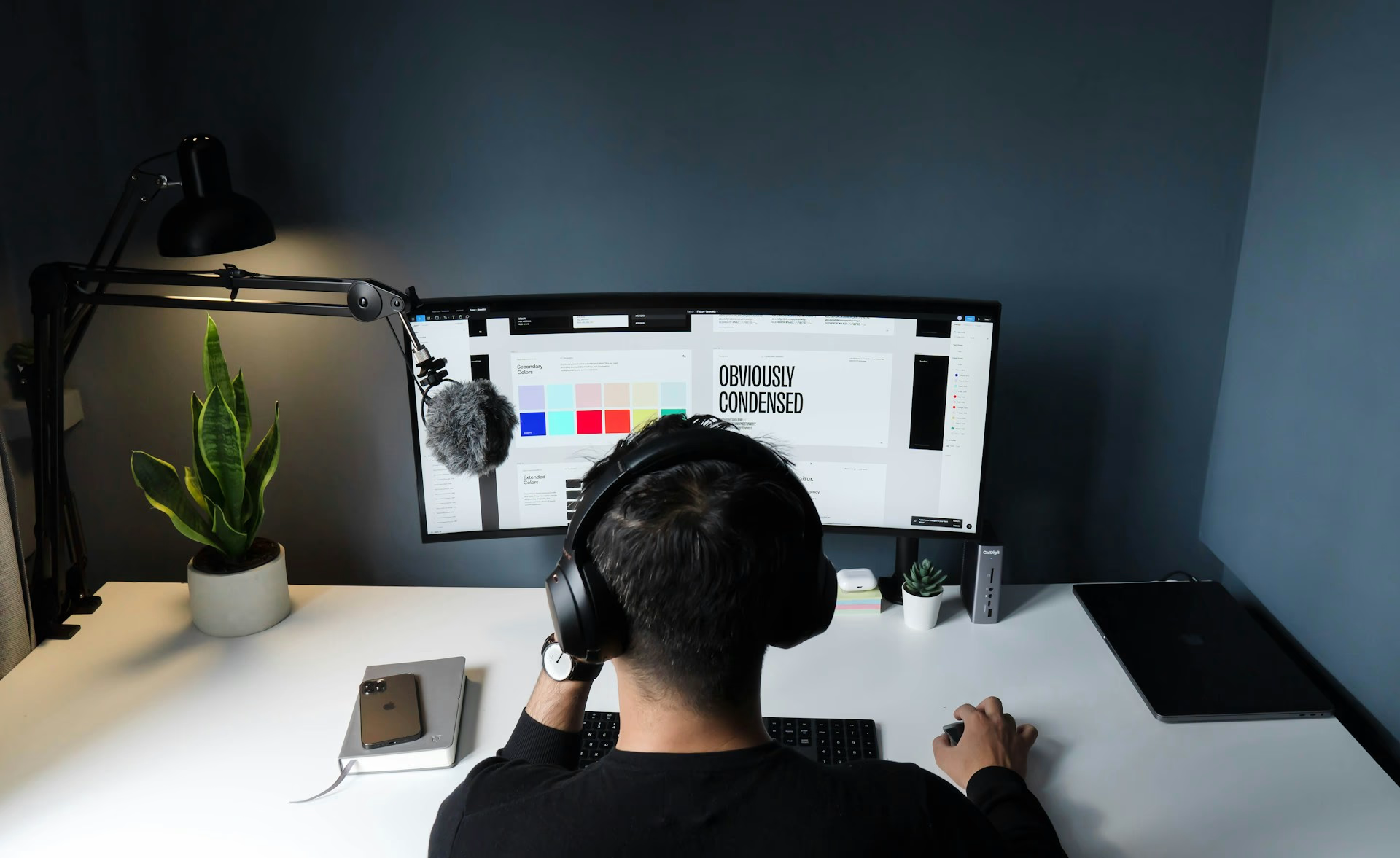
Co-managed IT services give internal technology teams access to outside skills, tools, and operational capacity without handing over the entire IT function. The model can cover help desk support, infrastructure monitoring, cybersecurity, cloud operations, DevOps, application maintenance, or specialist engineering. Some providers deliver formal co-managed MSP programs, while others work as embedded technical partners for selected parts of the environment. The right scope depends on which responsibilities an internal team wants to retain and where additional expertise or coverage is needed.
Gilzor works well for organizations that need the software engineering side of a co-managed IT model rather than a conventional outsourced help desk. Its development support service covers feature enhancements, application maintenance, technical troubleshooting, vendor transitions, and continued work on existing products. The company also works with AWS, Docker, Kubernetes, Ansible, CI/CD tooling, databases, backend systems, and cloud infrastructure.
This setup can complement an internal IT or product team that retains ownership of business systems while using Gilzor for application engineering, DevOps, cloud deployment, QA, and ongoing product support.

VC3 has a dedicated co-managed IT offering built specifically for organizations that already employ internal IT staff. The service is modular, allowing clients to retain control of their team while adding outside resources for infrastructure, end-user support, cybersecurity, backup, disaster recovery, and other functions.
Its infrastructure option includes 24/7 monitoring and maintenance, while the end-user service can provide round-the-clock support, patch management, and workstation monitoring. VC3 also offers co-managed cybersecurity for organizations that need additional security resources without creating a full internal security operations capability.
OSKI Solutions combines managed IT with application engineering, cloud operations, DevOps, maintenance, integration, and cybersecurity. Its managed IT service covers monitoring, incident response, patching, backups, databases, integrations, CI/CD pipelines, and AWS or Azure infrastructure.
For co-managed environments, that engineering depth is useful when an internal team needs outside specialists who can investigate issues beyond basic ticket handling. OSKI can also add dedicated development capacity and take over inherited systems, giving organizations flexibility to divide responsibilities across internal staff and an external engineering team.
Dataprise provides co-managed IT services for midsized organizations that want to keep their internal IT team in control while adding operational capacity. Its offering includes 24/7 end-user support, proactive monitoring, cybersecurity, compliance assistance, disaster recovery, infrastructure support, cloud migration, and strategic guidance.
The service is designed for companies that may have capable internal personnel but lack enough staff for continuous coverage or specialized projects. Dataprise also provides named service delivery and account management contacts, reporting, assessments, and live documentation of the IT environment.
A-listware explicitly supports both fully managed and co-managed IT arrangements. Its managed services can integrate with an existing IT department or other vendors, while its wider infrastructure practice covers servers, cloud environments, user management, networks, applications, security, and technical support.
The company provides L1 through L3 support, continuous infrastructure monitoring, cloud management, managed DevOps, application services, and cybersecurity work. Its co-sourcing model also allows specialists to supplement an internal IT department while the client maintains direct oversight of selected responsibilities.

Coretelligent structures its co-managed IT services around shared responsibility with an internal technology department. Businesses can outsource selected functions rather than the complete IT environment, including help desk operations, cybersecurity, cloud management, backup, disaster recovery, and strategic planning.
Its model is particularly relevant where an internal team wants to preserve control of core decisions but needs more operational coverage or specialist expertise. Coretelligent can provide comprehensive support or act as backup for in-house staff, and its cloud services cover public, private, and hybrid environments.
Mobian uses an outstaffing model in which engineers join the client's existing team and work within its systems and workflows. Available capabilities include cloud infrastructure management, DevOps and automation, databases, cybersecurity consulting, software QA, system integration, and frontend and backend development.
The company also provides post-launch support, performance monitoring, and scaling assistance. This makes Mobian more relevant to the engineering and application side of co-managed IT than to traditional end-user help desk management. Businesses can use individual specialists or a broader dedicated team to fill technical gaps without transferring ownership of the whole IT function.
Ntiva's co-managed service is designed to extend an existing IT department without replacing it. Organizations can choose individual functions based on their capacity gaps, including a 24/7 help desk, network monitoring, security services, employee onboarding and offboarding, patching, documentation, backup, and disaster recovery.
The approach suits teams that already understand their internal environment but need a larger support bench, after-hours coverage, or skills that would be difficult to maintain internally. Ntiva also positions co-management as an ongoing partnership rather than occasional break-fix support.
Itexus can complement an internal technology organization with dedicated teams, DevOps engineers, cloud specialists, QA, application support, and project rescue services. Its dedicated teams are designed to act as extensions of in-house teams, while its DevOps practice works with AWS, Azure, Google Cloud, infrastructure as code, monitoring, backups, containers, and CI/CD.
The company also provides ongoing L2 and L3 software support for production systems, including monitoring, incident response, patching, releases, performance tuning, backup, and rollback support. This makes Itexus most relevant when co-managed IT requirements are centered on applications, fintech systems, DevOps, or cloud engineering.
Integris offers fully managed and co-managed IT, with its co-managed model designed for organizations that already employ technology personnel. The provider can add infrastructure management, monitoring, maintenance, escalation support, cybersecurity, compliance assistance, cloud expertise, and strategic guidance while internal staff stay involved in daily operations.
Its offering has a particularly strong focus on regulated organizations. Financial institutions, for example, can combine internal IT resources with Integris support for security operations, governance, compliance, modernization, and infrastructure management.
.webp)
net-devs focuses on enterprise engineering rather than traditional managed help desk services. Its teams cover enterprise software, AI engineering, cloud-native architecture, infrastructure as code, platform engineering, frontend development, testing, deployment, and continued product iteration.
The company's senior-led delivery model can fit organizations that want to retain technology ownership while adding external engineering capacity for software, platform, or cloud work. It supports Azure, AWS, and Google Cloud and can continue evolving systems after production deployment, making it a specialist option for the development and platform layer of a co-managed technology environment.
%20(7).webp)
SoftPro provides custom software, cloud development, migration, infrastructure management, and long-term application support. Its cloud work includes AWS and Azure environments, lift-and-shift migration, containerization, cloud-native re-architecture, and infrastructure management.
For an internal IT team, SoftPro is better suited to co-managing applications and cloud workloads than handling general workplace IT. The company provides continuous support and maintenance for software it develops, which can make it useful when internal staff want to retain business ownership while an external engineering team manages selected systems or development workloads.
21century.tech is another specialist engineering option rather than a conventional co-managed MSP. The company operates as an AI-native software studio, with senior engineers handling architecture, business logic, code review, security decisions, testing, CI/CD, documentation, and production deployment.
For businesses with an established internal technology function, this model can be used to add development capacity for features, integrations, refactoring, or application delivery while the internal team maintains broader ownership of IT operations. Its scope is most appropriate for project-based software engineering and production delivery rather than end-user support, networking, or full infrastructure management.
Co-managed IT works best when responsibilities are defined clearly rather than simply adding another vendor to an already complex technology environment. Internal teams should know which systems they own, which issues should be escalated externally, and how monitoring, security, documentation, and incident response will be shared. Traditional MSPs are often the better fit for help desk, endpoints, networks, cybersecurity, and round-the-clock operations, while specialist engineering companies can fill narrower gaps in cloud, DevOps, software, or AI. Service levels, access controls, documentation standards, and knowledge transfer deserve particular attention before an engagement begins. A well-structured arrangement should expand internal capacity without making ownership of critical systems less clear.



.webp)