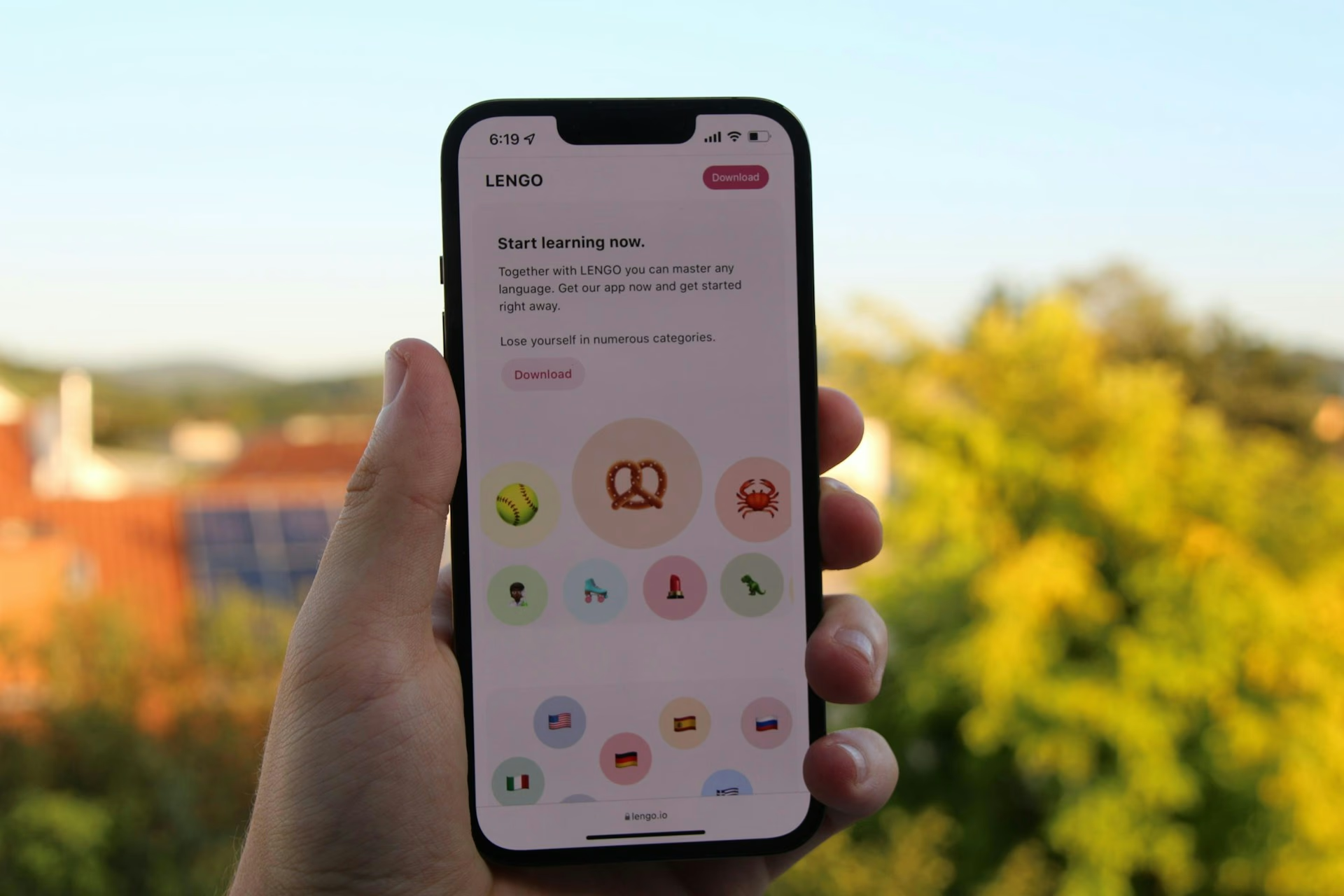
Progressive web apps have become a practical choice for businesses that want the reach of a website without giving up the speed and responsiveness people expect from native mobile applications. A well-built PWA loads quickly, works across different screen sizes, supports offline usage, and can be installed directly from the browser without requiring an app store. For companies serving customers on multiple devices, this approach often reduces development overhead while maintaining a consistent user experience.
Choosing the right development partner involves more than checking whether a company has PWA experience. Architecture, front-end engineering, API integration, performance optimization, caching strategies, security, and long-term maintenance all influence how well an application performs after launch. The companies below deliver Progressive Web App development services in the USA, ranging from startups building new digital products to enterprises modernizing existing web platforms.

Gilzor works with startups, software companies, and established businesses across the USA that want to turn websites or web platforms into progressive web apps without sacrificing performance, usability, or future flexibility. We look at how people actually use a product - switching between devices, dealing with unstable connections, or returning to the same application throughout the day - and shape the solution around those real situations instead of adding PWA functionality as an afterthought.
Because a PWA rarely exists on its own, we also design interfaces, build custom web applications, connect internal and third-party APIs, improve performance, strengthen security, and support the product after launch. This allows us to create PWAs that fit into existing business systems and remain practical to maintain as the product grows.


Zazz centers its progressive web app practice on building applications that behave like native software while remaining accessible through the browser. Rather than treating PWAs as simplified websites, the company engineers installable web applications with responsive interfaces, app shell architecture, and offline capabilities designed to keep performance consistent across smartphones, tablets, and desktop devices.
Migration projects are another area of focus, helping businesses replace traditional websites or legacy applications with Progressive Web Apps that are faster to access and easier to maintain. Zazz also covers consulting, quality assurance, performance optimization, and long-term maintenance, allowing clients to refine and support their applications after deployment instead of stopping at the initial release.
Simpalm places strong emphasis on progressive web apps that remain fast and usable regardless of device, browser, or network quality. Its engineering team builds applications around features such as offline access, home screen installation, background synchronization, and push notifications, allowing businesses to deliver an app-like experience without requiring users to download software from an app store.
The company's work extends well beyond the initial build. Simpalm designs user interfaces, implements headless backend architectures, optimizes applications with the App Shell model, and carries projects through testing, security reviews, and long-term maintenance. It also incorporates AI-powered capabilities - including intelligent search, recommendations, chatbots, voice search, and predictive analytics - when businesses want their PWAs to deliver more personalized customer interactions.

ManekTech gives considerable attention to helping businesses move from conventional websites to progressive web apps without disrupting existing data or online operations. Migration is treated as part of the engineering process rather than a separate service, with the company combining secure data transfer, responsive design, and browser compatibility to deliver applications that feel closer to native software while remaining accessible on the web.
Its PWA capabilities also cover custom application development, App Shell architecture, quality assurance, and search-engine-friendly implementation. Security is built into the development process through HTTPS and encrypted communication, while ongoing maintenance keeps applications aligned with evolving technologies after deployment instead of leaving clients to manage updates on their own.
iQlance positions progressive web apps as an alternative for businesses that want native-style performance without introducing the complexity of separate mobile applications. The company works with startups, mid-sized organizations, and enterprise clients, creating browser-based applications that combine responsive interfaces, fast loading times, and cross-platform compatibility within a single solution.
Its engineering capabilities extend into custom web and software development, allowing PWAs to connect with broader business platforms instead of functioning as standalone products. By combining UI/UX design, backend development, and ongoing technical support, iQlance helps organizations expand existing digital products while keeping the experience consistent across different devices.
Radixweb approaches progressive web app development from an enterprise engineering perspective, giving equal attention to application architecture, long-term scalability, and operational performance. Its projects frequently involve complex integrations, cloud-native infrastructure, API-first development, and optimization strategies that allow PWAs to remain responsive even when handling demanding workloads.
The company also supports organizations modernizing existing software rather than starting from scratch. Migration planning, performance tuning, quality assurance, AI integration, and application modernization are incorporated into the broader development lifecycle, making Progressive Web Apps one part of a larger software transformation strategy.

Sapphire Software Solutions combines progressive web app development with broader digital product engineering, creating browser-based applications that can adapt to changing business requirements as projects evolve. The company works across multiple industries, delivering responsive web experiences that emphasize usability, accessibility, and reliable performance on different devices.
Rather than limiting its involvement to front-end implementation, Sapphire Software Solutions also contributes backend development, cloud integration, quality assurance, and post-launch support. This wider technical scope allows businesses to continue extending their PWAs as new features, integrations, or operational requirements emerge.

TechAhead treats progressive web apps as part of a broader software engineering strategy rather than a standalone web service. Its projects combine modern JavaScript frameworks, cloud infrastructure, API integration, and enterprise architecture to produce applications that remain responsive under growing workloads while supporting long-term product evolution. This engineering-first approach is reflected in the company's structured delivery process and emphasis on scalability, security, and continuous improvement.
Instead of ending its involvement at deployment, TechAhead continues refining applications through performance monitoring, feature enhancements, and ongoing maintenance. The company also assists organizations with product strategy, legacy system modernization, UX design, testing, and secure deployment, making Progressive Web Apps one element within a wider digital transformation initiative.

VT Netzwelt builds progressive web apps with particular attention to usability on mobile devices, combining responsive interfaces with installation support, offline functionality, and application shell architecture. The company also helps businesses convert existing websites into PWAs, allowing them to reach users through a faster and more flexible web experience without relying on traditional mobile app distribution.
Its involvement continues through testing, security reviews, maintenance, and regular application updates, helping clients keep their PWAs reliable as browsers and technologies evolve. Alongside Progressive Web Apps, VT Netzwelt delivers custom web development, frontend engineering, backend integration, and digital product services that support larger software ecosystems.
Andersen brings progressive web apps into larger software ecosystems where compatibility with existing business platforms is just as important as front-end performance. Instead of focusing solely on the user interface, the company pays equal attention to system integration, migration planning, and application architecture, helping organizations introduce PWAs without disrupting established workflows.
Another distinguishing aspect of Andersen's work is the combination of consulting, UX design, and quality assurance within the same delivery process. From early technical planning through deployment and ongoing support, the company helps businesses build Progressive Web Apps that fit naturally into enterprise environments while remaining responsive across browsers and devices.

Albiorix Tech approaches progressive web apps as an opportunity to replace separate mobile and web experiences with a single application that remains fast, responsive, and accessible across different devices. Its projects range from creating new PWAs to transforming existing websites into installable applications with native-like interaction and improved browser performance.
The company also applies its JavaScript and TypeScript expertise to support the technical foundation behind those applications. Responsive interface design, application shell architecture, migration, testing, and custom software engineering are combined into development projects that can continue evolving as business requirements change.
CodeCraft Technologies focuses its PWA work on situations where loading speed and unstable connectivity directly affect whether users stay or leave. The company creates browser-based applications that can continue operating in low-network conditions, support background activity through service workers, and give users quick access without the usual app-store installation process.
Its delivery model covers the full path from early consultation and proof of concept to interface design, engineering, testing, and deployment. CodeCraft Technologies also works across fields such as healthcare, energy, banking, manufacturing, real estate, and IoT, adapting PWA architecture to different operational requirements rather than relying on the same setup for every project.
CMARIX frames progressive web app development around continuity across devices, combining the broad reach of the web with the responsiveness people usually associate with mobile applications. Its work covers custom PWA engineering, interface design, plugin development, and application shell architecture, with particular attention to fast loading, offline access, push notifications, and automatic updates.
Rather than treating launch as the end of the project, CMARIX also handles migration, quality assurance, security checks, and ongoing maintenance. This makes the company suitable for businesses that need either a new Progressive Web App or a gradual upgrade from an existing web platform while keeping future expansion in mind.
WEZOM concentrates on the practical limitations that often make traditional web applications frustrating to use. Its progressive web apps are designed to preserve important functions when connectivity drops, reduce loading delays through caching and compression, and remove the installation barriers that can discourage people from trying a new application.
The company also positions PWA development as a cost-conscious alternative to maintaining separate native products for several platforms. Automatic background updates, browser-based access, and native-style interactions help businesses create a more consistent experience without forcing users to manage downloads or manual upgrades.

The App Founders Studio combines progressive web app development with backend engineering, interface design, deployment, and quality assurance. Its teams create PWAs that can use device capabilities while remaining accessible through the browser, giving businesses a middle ground between a conventional website and a native mobile product.
Security and usability receive particular attention throughout the build. HTTPS delivery, responsive layouts, App Shell architecture, offline compatibility, and search-friendly implementation are used to improve both technical performance and day-to-day accessibility. The company also supports migration from existing websites and continues working on the application after release through maintenance and troubleshooting.
Maxtra Technologies looks at progressive web apps through the lens of browser capability and network conditions. Its work relies on service workers, caching, and background processes to keep applications responsive even when a connection is slow or temporarily unavailable. This makes its PWA offering especially relevant for businesses that need broad reach without forcing users to install a conventional mobile app.
The company supports startups, smaller businesses, and enterprise projects with design, migration, security, and post-launch assistance. Maxtra Technologies also helps clients decide which functions should remain available offline and how navigation should behave across different browsers, rather than assuming that every web product needs the same PWA setup.

HashStudioz Technologies uses a single-codebase model to create progressive web apps that remain consistent across browsers, screen sizes, and operating environments. Service workers and web app manifests form the technical base, supporting installation, offline use, and smooth navigation without splitting development into separate native products.
Its portfolio reaches beyond standard business applications. HashStudioz Technologies works with e-commerce platforms, static web apps, augmented reality features, and data-intensive systems, while also handling responsive design, App Shell architecture, secure migration, and quality assurance. That range gives the company room to adapt PWA development to products with very different levels of interaction and technical complexity.
Centric Tech presents progressive web apps as a practical way for businesses to close the gap between traditional websites and native mobile applications. Its development process focuses on creating applications that remain fast, installable, and responsive while supporting features such as offline access, push notifications, and seamless interaction across smartphones, tablets, and desktop browsers.
The company stays involved beyond the initial release by assisting with system integration, performance improvements, and long-term maintenance. Whether the project requires a completely custom PWA or the addition of new web capabilities to an existing business platform, Centric Tech combines design, engineering, and ongoing technical support to keep applications reliable as business needs evolve.

Surf uses Flutter to reduce the usual divide between web, iOS, and Android development. Instead of creating several independent products, the company can adapt one codebase for multiple platforms, including a Progressive Web App. This approach is especially useful for businesses that want to launch faster, simplify maintenance, and avoid paying for separate teams to build nearly identical functionality.
Its PWA work is closely tied to product engineering rather than limited to browser optimization. Surf considers how the application will scale, how updates will be released, and whether the same foundation can support mobile versions later. The company has worked with fintech, e-commerce, and entertainment products, where security, streaming, transactions, and frequent updates can all shape the final architecture.

A-listware includes progressive web app development within its broader web and mobile engineering practice, helping businesses deliver browser-based applications that behave much like native software. Its teams build PWAs alongside custom web platforms, allowing organizations to reach desktop and mobile users through a single application while simplifying future maintenance and feature updates.
The company also works across cloud infrastructure, backend development, AI integration, and DevOps, making it suitable for projects where a progressive web app is only one component of a larger digital ecosystem. This wider engineering capability helps businesses extend their applications as operational requirements evolve instead of treating the PWA as an isolated product.

Itexus is primarily recognized for custom web and software development, with experience building responsive browser applications for businesses across finance, healthcare, and other technology-driven sectors. Although progressive web apps are not presented as a standalone service, the company's expertise in modern web engineering, frontend development, and scalable application architecture makes it capable of delivering projects that incorporate PWA technologies where they fit business requirements.
Its broader development practice covers product design, backend engineering, cloud integration, and long-term software maintenance, allowing web applications to grow beyond their initial release. For organizations planning a custom digital product rather than a standard marketing website, this wider technical scope can provide flexibility as new functionality is introduced.
Progressive web app development companies in the USA differ more than their service pages may suggest. Some focus on enterprise architecture, system integration, and modernization, while others concentrate on Flutter delivery, offline access, App Shell implementation, migration, or performance under weak network conditions. The strongest choice is therefore not simply the company with the longest service list, but the one whose technical strengths match the way the product will actually be used.
Before selecting a partner, businesses should look closely at existing infrastructure, required integrations, security expectations, support needs, and plans for future expansion. A PWA meant for e-commerce, internal operations, financial services, or media delivery will require a different balance of design, backend engineering, caching, testing, and maintenance. Comparing the companies on those practical factors makes it easier to find a team that can deliver more than an installable website and build a product that remains useful after launch.